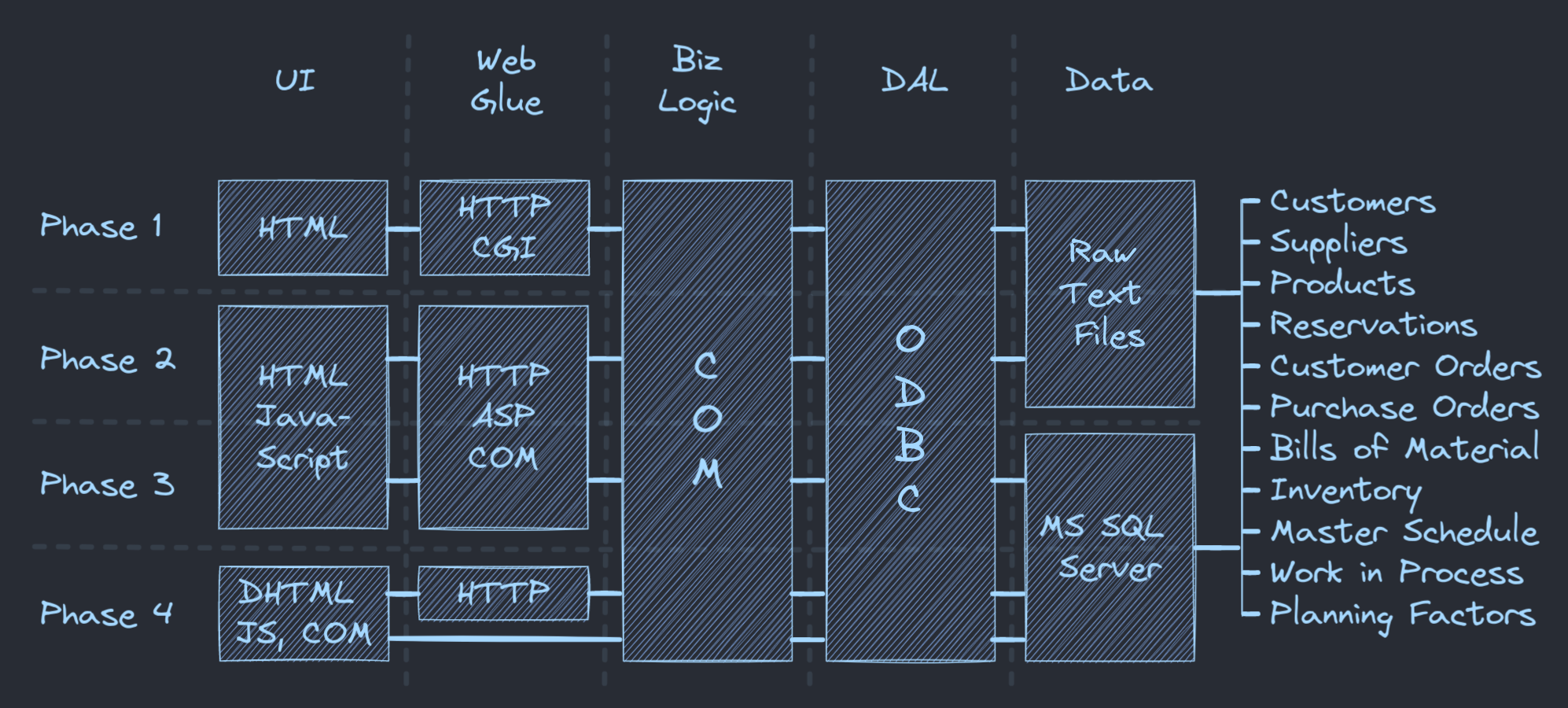
Fig 1: Adaptive Solution Architecture
In the 1990s, I led the development of a pioneering full stack application named PowerQuery to support the operations for Lucent Technologies' Wireless Division. It integrated operational data from eleven different sources and served up interactive results to users via a web browser, replacing static paper reports. This application was an early example of integrating various technologies like Server-side Scripting, COM, ActiveX, DHTML and ODBC. Designed as an evolving solution, PowerQuery was built with a modular architecture, enabling the application to integrate new technologies without disrupting existing operations. This approach allowed the application to stay relevant and useful for over a decade, demonstrating its capacity for growth and adaptation in an ever-evolving technology landscape.
At that time, the Internet was undergoing transformative changes. It was a period marked by rapid technological advancements and the increasing popularity of the web as a platform for a wide array of applications. Businesses and individuals alike were beginning to recognize the vast potential of the internet for information sharing, commerce, and communication. The half-life of technology was quickly accelerating, demanding that engineers embrace forward-compatible design concepts and explicitly build things to evolve.
The primary objective of the PowerQuery project was to transform the way Lucent Technologies' Wireless Division managed and interacted with its operational data. At its core, the project aimed to:
In pursuit of these objectives, PowerQuery was poised to become a cornerstone in the digital transformation journey of Lucent Technologies, paving the way for advanced, efficient, and adaptable business processes.
In the mid-1990s, the landscape of Internet technology was rapidly transforming, marking an era of significant innovation and growth. This period was characterized by the emergence of new web technologies and the evolution of existing ones, leading to a dynamic and somewhat unpredictable digital environment. Companies and developers were exploring the potential of the Internet, which was quickly transitioning from a mere information-sharing platform to a robust medium for complex, interactive applications. Amidst this technological boom, there was a pressing need for solutions that were not just effective with the current technology but also adaptable enough to incorporate future advancements. Recognizing this need, the development of PowerQuery was initiated with a clear vision: to create an application that was designed from the ground up to evolve. This forward-thinking approach aimed to ensure that PowerQuery would not only meet the immediate operational requirements of Lucent Technologies' Wireless Division but also remain relevant and efficient as new technologies emerged and the digital landscape continued to shift.
Fig 1: Adaptive Solution Architecture
The initial phase utilized CGI (Common Gateway Interface), COM components, and ODBC drivers with flat ASCII text files. This phase was marked by a focus on creating reusable components and abstracting data services for future scalability.
With the advent of server-side scripting, Microsoft’s Active Server Pages (ASP) replaced CGI. The application began transitioning to SQL Server, a DBMS, to enhance performance. ODBC's role in abstracting data services facilitated this shift without disrupting existing operations.
The complete integration of SQL Server marked this phase. The switch to a DBMS significantly improved performance, with changes in the ODBC connection string seamlessly connecting the new database system.
The final phase introduced DHTML and client-side ActiveX components. This phase focused on improving the user experience, with features like client-side caching and data manipulation.
The PowerQuery project, driven by ambitious objectives, had a significant and lasting impact on Lucent Technologies' Wireless Division:
In essence, PowerQuery was not just a tool for the present; it was a vision for the future. It exemplified how embracing technological advancements and anticipating future trends could create solutions that were not only effective in the present but also adaptable for the future. As a result, PowerQuery significantly contributed to reshaping the operational and strategic framework within Lucent Technologies, fostering a culture of innovation and efficiency.
Reflecting on how PowerQuery might evolve with today's technologies and best practices, a transition to a stack like PERN seems a natural progression. Modernizing the backend with Node.js and Express would enhance scalability and API integration. The frontend could be revitalized using React and Redux for dynamic user interfaces and efficient state management. Incorporating RESTful APIs, WebSocket for real-time updates, and advanced security protocols would further enhance the application's capabilities. By continuing to focus on modular design and adapting to technological advancements, PowerQuery could maintain its evolutionary ethos, demonstrating a capacity for growth and adaptation in an ever-evolving technology landscape.
In addition to the PERN stack, infusing PowerQuery with AI capabilities offers another frontier for modernization. By integrating machine learning algorithms and large language models (LLMs), the application could feature advanced natural language processing (NLP). This would allow users to interact with PowerQuery using natural language queries, making the tool more intuitive and accessible. AI-driven analytics could provide deeper insights through predictive modeling and trend analysis, enhancing decision-making processes. Furthermore, the implementation of AI could automate routine tasks, optimize operational workflows, and adapt to user behavior, continually evolving the application's efficiency and effectiveness. Such AI integration would not only align with current technological trends but also propel PowerQuery into the realm of intelligent, user-centric applications, further demonstrating its adaptability in a rapidly evolving digital landscape.
There are many other modernization considerations that could be incorporated as well. To name a few: cloud computing for scale and cost efficiency, containerization and microservices for modularity, blockchain for enhanced security, IoT integration, user experience/accessibility, and sustainable computing practices.